
Ecommerce privacy compliance means your storefront, checkout funnels, and tracking pipelines must respect visitor consent choices under GDPR and CCPA. In practice, retail architectures often break. Data leaks across subdomains, payment gateways, and server-side feeds before shoppers consent. Regulators now run automated sweeps on live retail funnels. Engineering teams must identify where technical configurations fail under European and US privacy laws.
The checkout funnel consent gap across store subdomains
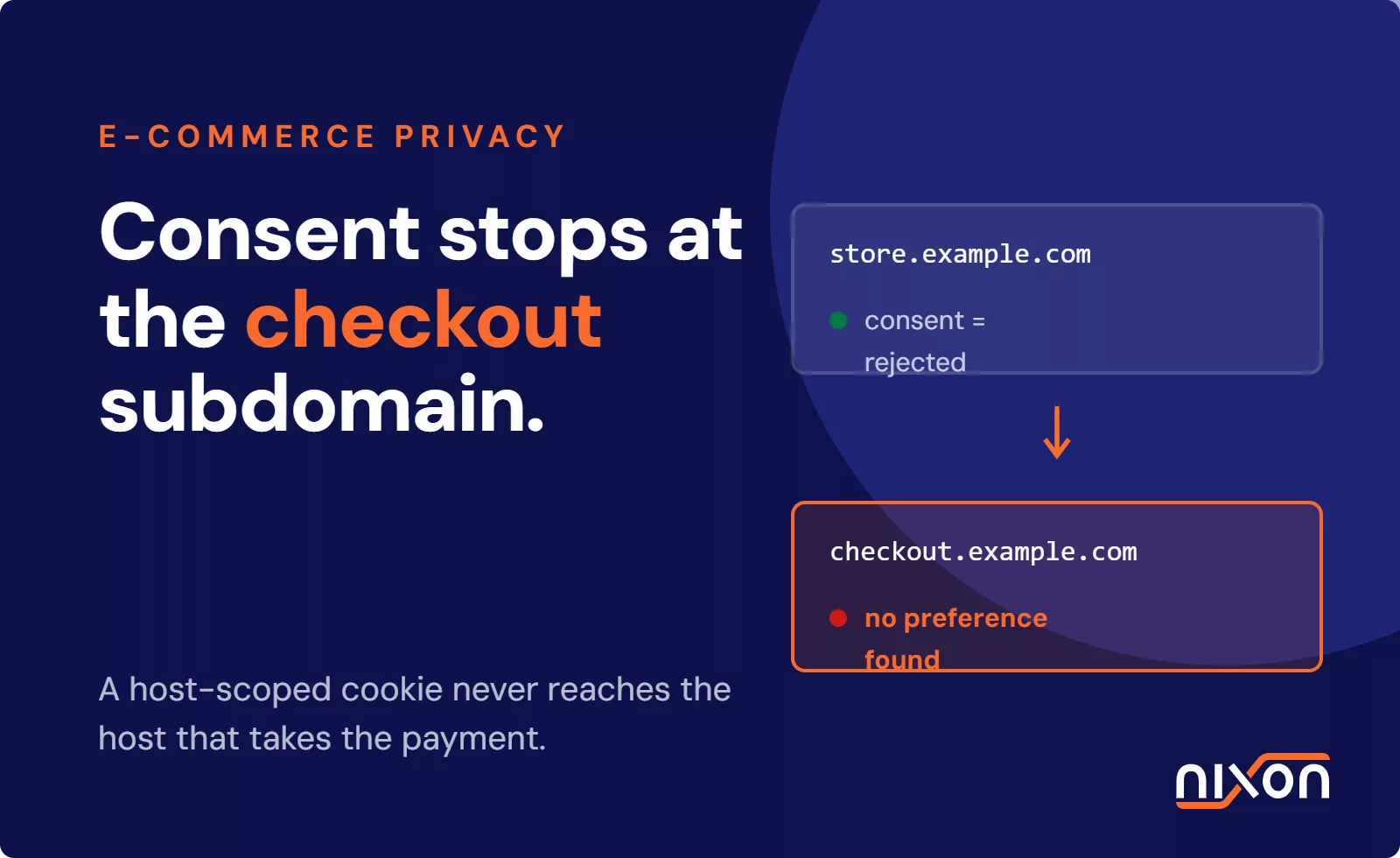
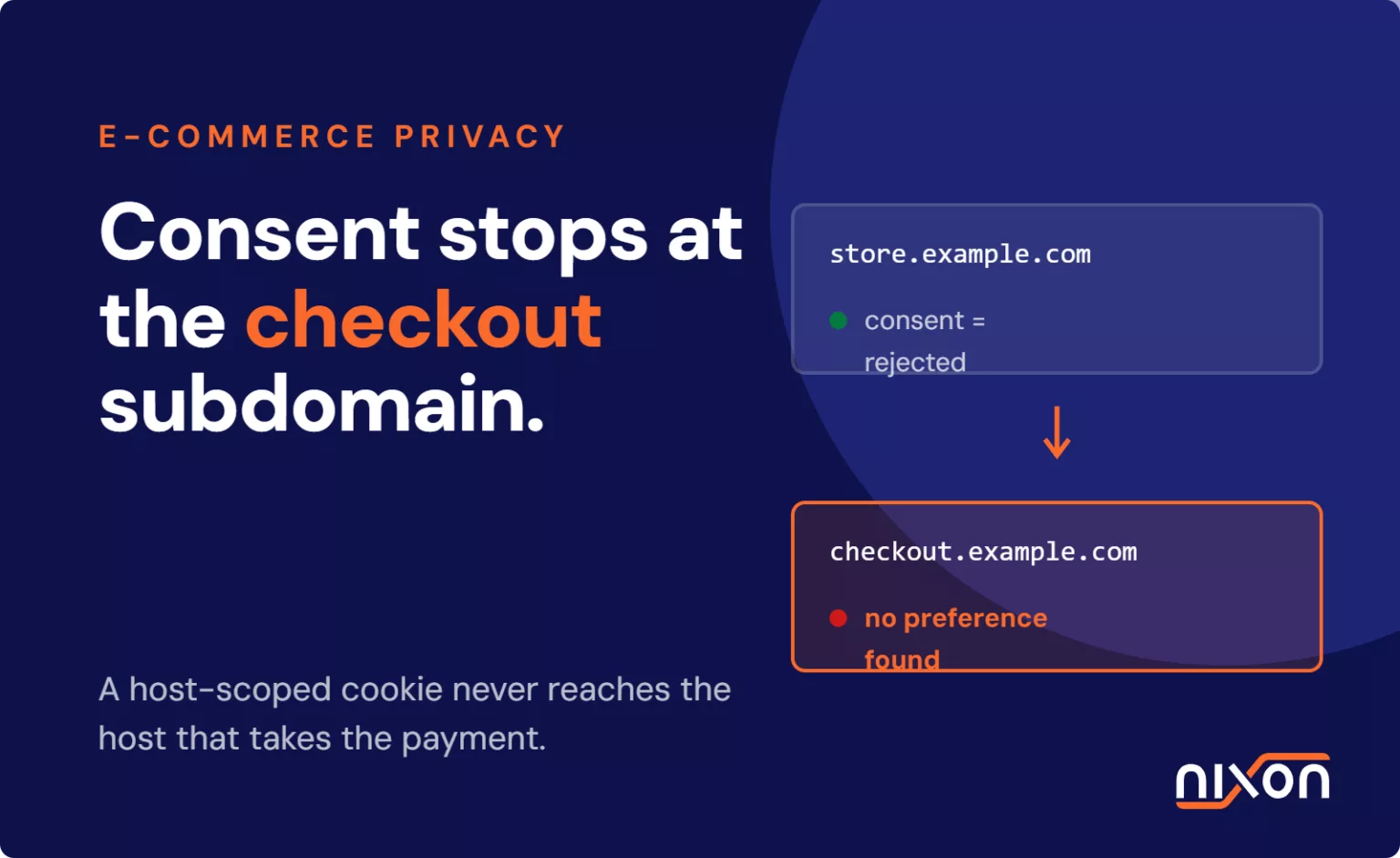
Online retail platforms often split browsing catalogs from checkout systems. This separation is done to optimize hosting performance, isolate payment data, or integrate specialized software. For example, a shopper browses products on store.example.com but completes the purchase on checkout.example.com. When we audit platforms like Shopify, Adobe Commerce, and custom web apps that redirect across subdomains, this setup is a common point where consent is lost. Under EU and US privacy laws, recorded consent must persist throughout the entire customer journey, but standard retail setups fail to maintain this continuity.
Subdomain cookie inheritance failures
Consent management platforms (CMPs) store visitor choices in first-party cookies or browser localStorage. If a user rejects tracking on store.example.com, the CMP writes a cookie scoped strictly to that host, provided developers omit the domain attribute. The browser then refuses to share this record with checkout.example.com. When the shopper arrives at the checkout subdomain, it detects no existing preference. Instead of halting third-party scripts, the checkout environment immediately loads marketing pixels. Understanding the operational CCPA vs GDPR website compliance differences helps teams fix this flaw. Both opt-in rules and opt-out preferences require uniform propagation across all domain levels.
Consent state drops during checkout redirection
Hosted checkout platforms introduce deeper technical friction. When a store redirects a shopper to an external checkout service, cookies cannot cross distinct root domain boundaries. Stores sometimes attempt to pass consent parameters via URL query strings. However, frontend redirects frequently strip these parameters or fail to rehydrate CMP state before tags execute. Tag managers on the checkout page run triggers using default settings rather than recorded preferences. Consequently, high-intent transactional data, including cart contents and customer identifiers, flows directly to ad networks before the user interacts with any secondary banner.
Why server-side tagging does not bypass consent requirements
Engineering teams often move tracking to Google Tag Manager Server Container or use direct vendor APIs. They mistakenly believe server execution bypasses consent banners, but it does not. Moving data collection from the browser to a backend server does not alter legal obligations. Regulators assess data processing based on what information is gathered and shared, not the networking protocol used for transmission.
Meta Conversions API and server-to-server data flows
The Meta Conversions API is a standard server-side integration in modern retail. When a customer orders, the merchant server sends a payload directly to Meta endpoints. This payload contains customer details, order value, and browser identifiers. Retailers assume no consent is necessary because no external JavaScript ran in the browser. However, dispatching customer purchase events to an ad platform constitutes commercial processing. If your server sends this payload after an opt-out or before explicit consent, your store violates privacy regulations.
Legal reality of server-side data processing under GDPR and CCPA
Regulatory frameworks are clear on server-side payloads. The GDPR Article 4(1) definition of personal data covers any identifier that makes an individual identifiable, directly or indirectly. Hashing an email address with SHA-256 is a pseudonymous technique and does not anonymize data under EU law. Similarly, the California Consumer Privacy Act treats sending purchase details with hashed identifiers to adtech partners as a sale or share of personal information. Processing server-side tags without honoring consumer signals creates unmonitored compliance liability.
Third-party payment gateways and fraud detection leakage
Payment pages create compliance vulnerabilities where security code, fraud prevention tools, and ad trackers often converge. When you embed a payment gateway SDK, such as Stripe, to maintain PCI compliance, that client script can fire background network requests. These requests may leak shopper data outside transaction boundaries.
Piggybacked ad trackers within payment scripts
When engineering teams embed external payment widgets, they rarely audit script dependencies. Payment vendors sometimes bundle analytics, diagnostic beacons, and cross-merchant identification trackers within client-side code. These bundled scripts read browser environments, collect device parameters, and transmit telemetry to third-party endpoints. Online stores often fail to remove third-party trackers from website templates where sensitive checkout inputs reside. This leads to data leakage to external entities during the most critical stage of the funnel.
Distinguishing strictly necessary fraud prevention from commercial profiling
Privacy frameworks permit specific exemptions for fraud mitigation and transaction security. Under the CNIL cookie and tracker guidelines, trackers strictly necessary for providing an online service requested by the user do not require consent. Pure fraud detection engines that analyze browser parameters solely to prevent chargebacks qualify under legitimate interest or strictly necessary criteria. However, if a fraud detection vendor repurposes checkout device fingerprints to train external commercial identity graphs or build cross-merchant advertising profiles, this exemption collapses. Maintaining strict third-party vendor management for websites ensures your payment integrations do not monetize shoppers’ hardware profiles.
Enforcement reality: defective opt-outs and retail data sharing
Regulatory authorities now conduct automated technical sweeps of live commercial websites, moving beyond just reviewing corporate privacy policies. Retail stores face the highest scrutiny because consumer transactions generate immediate personal and financial records. Enforcement patterns show authorities systematically test the mechanical reality of retail websites, checking if frontend switches actually suppress downstream network requests.
The CPPA retail enforcement focus on broken opt-out signals
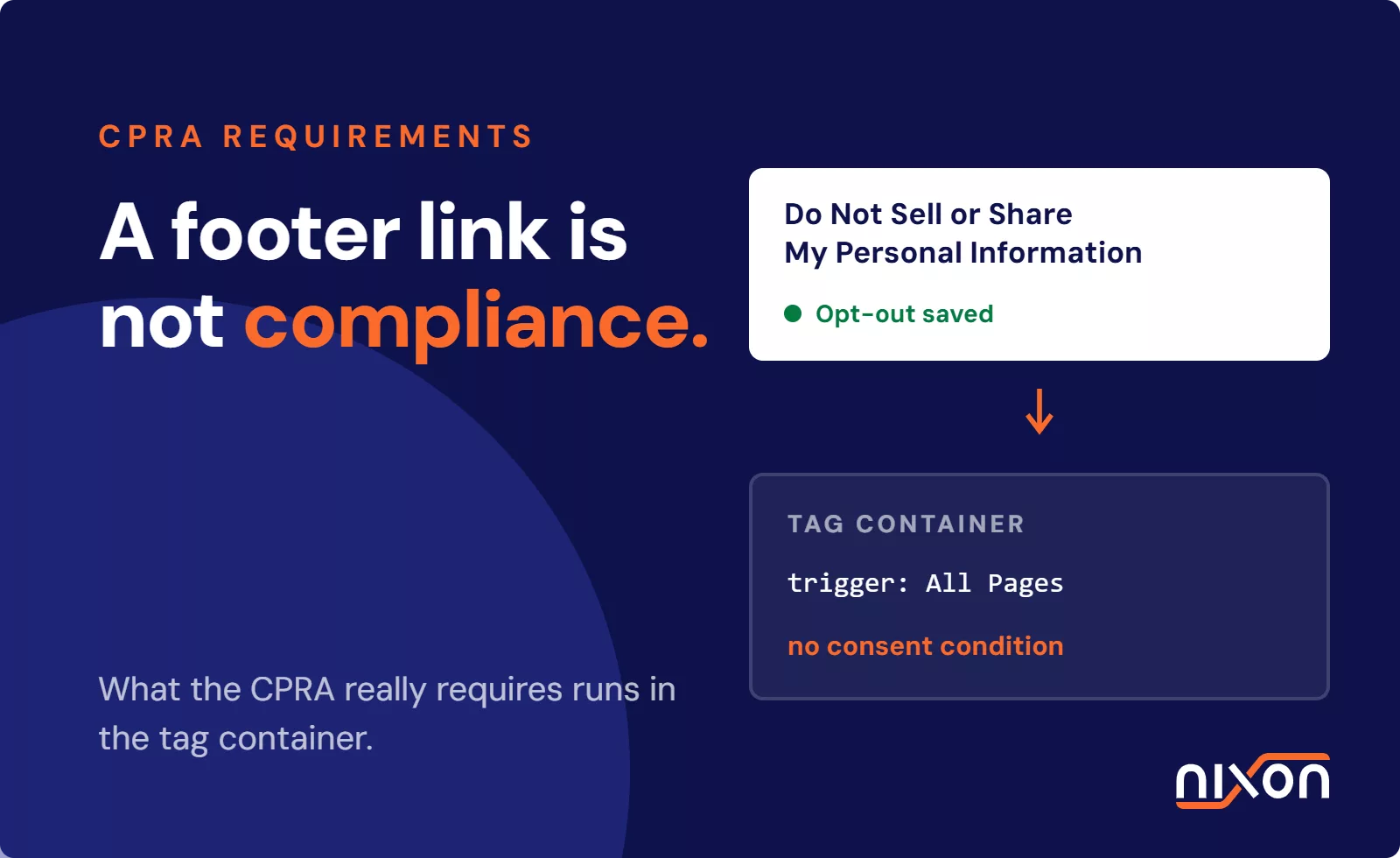
Recent CPPA enforcement actions demonstrate that California regulators actively test whether e-commerce platforms honor browser-level Global Privacy Control (GPC) signals. California law requires businesses to treat GPC broadcasts as valid consumer opt-out requests for the sale and sharing of personal data. Regulatory investigations found multiple retail websites where visual opt-out confirmations appeared, yet underlying tag managers continued broadcasting transaction data to advertising networks. Stores failing to publish compliant mechanisms that meet Do Not Sell My Personal Information link requirements face direct enforcement notices and substantial civil penalties.
Vendor contract traps: service providers versus third-party sharing
Under the CCPA and CPRA, passing consumer identifiers to an external partner is classified as selling or sharing unless that entity strictly qualifies as a service provider. A valid service provider contract must prohibit the vendor from retaining, using, or disclosing personal information for any purpose other than performing specific business services defined in the agreement. Many online merchants integrate marketing platforms using standard self-serve agreements. These grant the vendor broad rights to use ingested customer purchase histories for platform optimization. Without necessary contractual restrictions, every automated tag fire constitutes an unauthorized data sale under California law.
A technical checklist to audit your checkout funnels
Verifying e-commerce privacy compliance requires an empirical audit, not just a static policy review. Follow these core technical steps:
- Map domain boundaries: audit cookie scope and persistence between catalog subdomains and external checkout hosts.
- Audit tag manager triggers: inspect container firing rules across dynamic cart mutations to ensure marketing scripts wait for consent.
- Inspect server-side payloads: evaluate Meta Conversions API and server GTM pipelines to verify hashed personal data respects user signals.
- Review third-party payment scripts: inspect checkout network requests to isolate strictly necessary fraud code from piggybacked commercial trackers.
- Test opt-out states: verify that frontend rejection and browser-level GPC signals physically halt outbound marketing requests.
Engineering and compliance teams must inspect the raw network transactions across the complete buyer journey, from product discovery to final order confirmation. This technical verification ensures tag rules align with both legal requirements and user selections.
Mapping dynamic cart tags and tag manager triggers
Modern retail storefronts heavily rely on single-page application frameworks and dynamic document object model updates. When a customer adds an item to a cart or updates quantities, tag managers fire custom event listeners to capture interaction telemetry. During an audit, inspect your tag management container. Identify every trigger tied to dynamic cart mutations. Verify that tags categorized as advertising or behavioral profiling maintain strict blocking conditions linked to your CMP state. If a cart update event triggers an unconsented network beacon before a user grants permission, update the tag firing rule to depend on valid consent variables.
Validating consent propagation from cart to receipt
The final audit phase involves verifying network traffic through the entire transaction lifecycle. Open your browser developer tools and monitor the network console. Complete a test purchase under three scenarios: full consent granted, consent fully rejected, and browser-level GPC signal enabled. In the rejected and GPC-enabled test runs, confirm that no outbound network requests reach third-party marketing endpoints, including conversion pixels, session recording platforms, and social network APIs. Ensure the order receipt page respects the same consent boundaries established at the storefront entrance.
Maintaining e-commerce privacy compliance across multi-step funnels manually is time-consuming and misses dynamic network requests. To identify hidden tracker leaks, verify consent states, and inspect script behavior across your checkout flow, run a comprehensive website privacy audit with Nixon Pro. This provides your engineering team with the clear data needed to remediate issues immediately.
Frequently Asked Questions (FAQ)
Does server-side tracking eliminate the need for an ecommerce cookie banner?
No. Server-side tracking changes the data transport method, not the legal obligations. Under GDPR and CCPA, collecting personal identifiers and sharing customer transaction data with third parties for marketing purposes requires a legal basis and consent, regardless of whether requests originate from the user's browser or your backend server.
Why does consent often drop when shoppers move from shop catalog to checkout?
Consent records are commonly stored in browser cookies or localStorage tied to a single domain. When checkouts run on separate subdomains or external hosted platforms, the browser isolates that storage. Without explicit cookie domain configuration or URL parameter passing, the checkout environment loses the visitor's preferences and resets tracking.
Are fraud detection scripts exempt from GDPR and CCPA consent rules?
Fraud detection scripts can operate under strictly necessary exemptions or legitimate interest, but only if they strictly serve transaction security. If payment or fraud vendors repurpose that data for cross-merchant profiling, product improvement or commercial analytics, the exemption is void and prior user consent becomes mandatory.
How does the CPPA treat retail sharing with ad networks?
The CPPA classifies transmitting consumer purchase history and online identifiers to advertising networks as selling or sharing personal data. Retailers must honor Global Privacy Control signals, provide clear opt-out mechanisms and execute strict service provider contracts that prevent ad vendors from using the data for secondary purposes.
How often should an online store conduct an ecommerce privacy compliance audit?
Stores should conduct an audit at least quarterly, as well as immediately after any checkout redesign, tag manager update or new marketing script deployment. Automated testing ensures that ongoing template modifications, payment gateway updates and third-party script additions have not introduced silent data leaks.