
Third party tracker risks represent the data leakage and security vulnerabilities introduced when unvetted external scripts run on public web properties. Marketing teams push analytics tags directly through tag management containers without looping in security architecture or legal compliance. For enterprise CISOs, these scripts introduce client-side supply chain exposure, DOM tampering and unauthorised data exfiltration. For Data Protection Officers (DPOs), they trigger non-consensual personal data collection, unlawful cross-border transfers and GDPR non-compliance. Operating in departmental silos creates blind spots across enterprise web estates. This guide breaks down how shadow scripts bypass controls and how cross-functional asset discovery eliminates joint enterprise exposure.
Why third party tracker risks fall between security and privacy silos
Enterprise organisations routinely divide digital risk between technical protection and legal compliance. Security teams protect the network edge, infrastructure and core application code. Privacy teams maintain records of processing activities and configure consent banners. Tracking technologies land directly in the seam between these two mandates. Neither team fully owns client-side browser execution. As a result, marketing teams inject unreviewed code into public properties at will.
The CISO perspective on client-side script execution
From an information security perspective, every tracking script is executable code. It runs with full privileges inside the user browser session. When a page executes an external script, that code can read session tokens and observe form inputs. It can modify the DOM and transmit payloads to arbitrary remote servers. Traditional web application firewalls monitor incoming traffic at the server edge, but stay completely blind to browser-initiated data flows. Unmanaged tags represent an uncontrolled supply chain vector operating beyond standard endpoint protection.
The DPO perspective on consent and unlawful data transfers
Data Protection Officers evaluate these identical scripts through fundamental rights and statutory compliance. Under European data protection law, capturing a visitor device identifier or IP address requires an unambiguous legal basis. When scripts initiate tracking prior to user choice, organisations violate core GDPR Article 5 and 6 principles regarding lawfulness, fairness and purpose limitation. Trackers also transmit captured telemetry to overseas processing infrastructure, creating unreviewed international transfer liabilities under Chapter V of the GDPR. In the United States, unmonitored scripts trigger immediate enforcement exposure under the California Consumer Privacy Act (CCPA). Under Cal. Civ. Code § 1798.140, transmitting persistent identifiers or behavioral telemetry to adtech vendors constitutes a sale or sharing of personal data that requires explicit opt-out mechanisms and statutory disclosures.
The governance gap inside tag management systems
Tag managers give marketing a backdoor around release cycles and security reviews. Teams gain publish rights to support rapid campaign deployments without submitting code through standard pull requests. Scripts bypass code review, vendor risk assessments and consent mapping simultaneously. Proper third-party vendor management for websites requires technical validation of what scripts execute in production rather than passive reliance on paper procurement agreements.
How shadow tags create simultaneous regulatory and security exposure
Shadow tags rarely operate in isolation. In our client audits, we regularly see containers where a single tag initiates a complex cascade of downstream requests. This cascade amplifies both security exposure and compliance liability across the portfolio.
Unauthorised data exfiltration through piggybacking tags
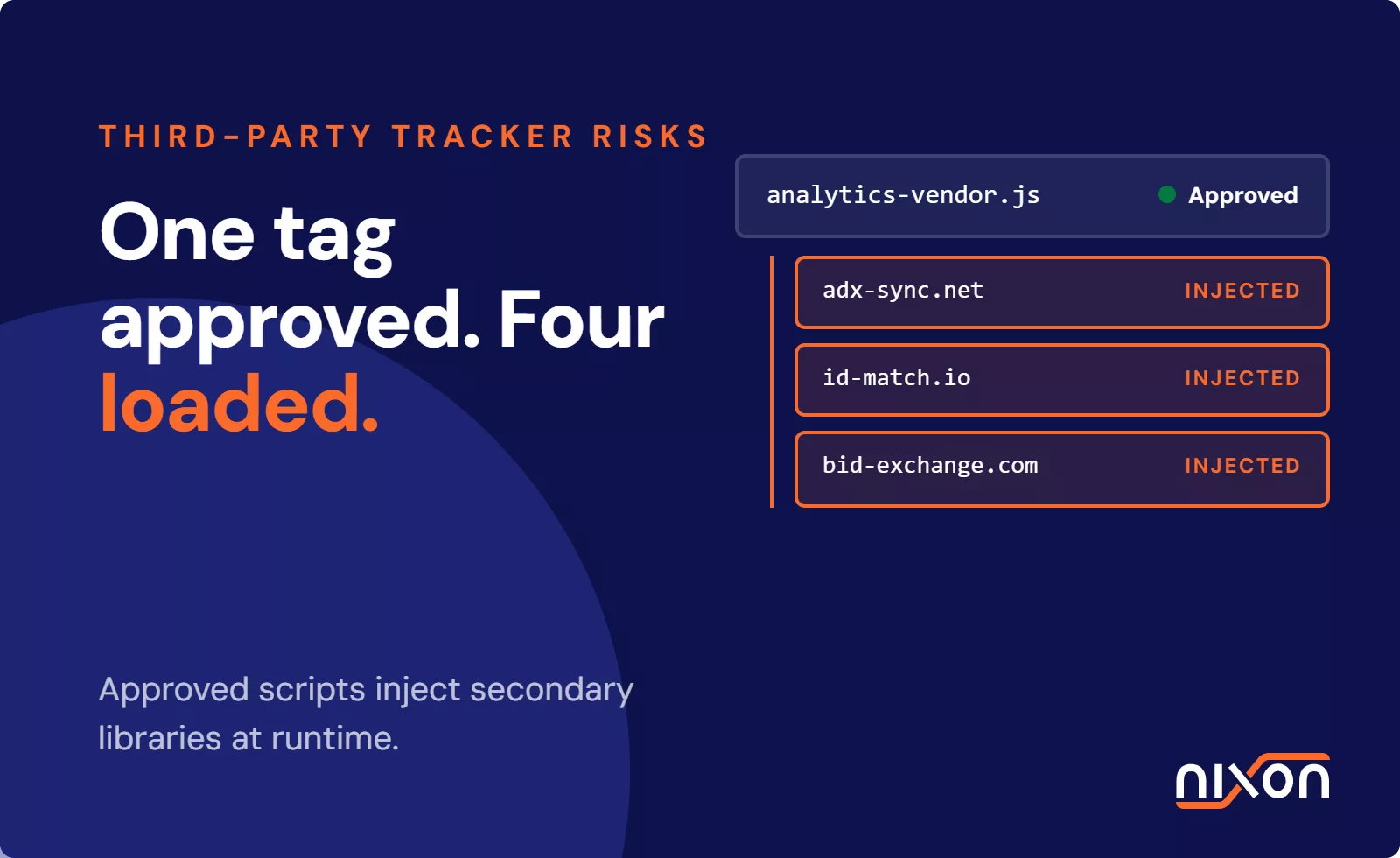
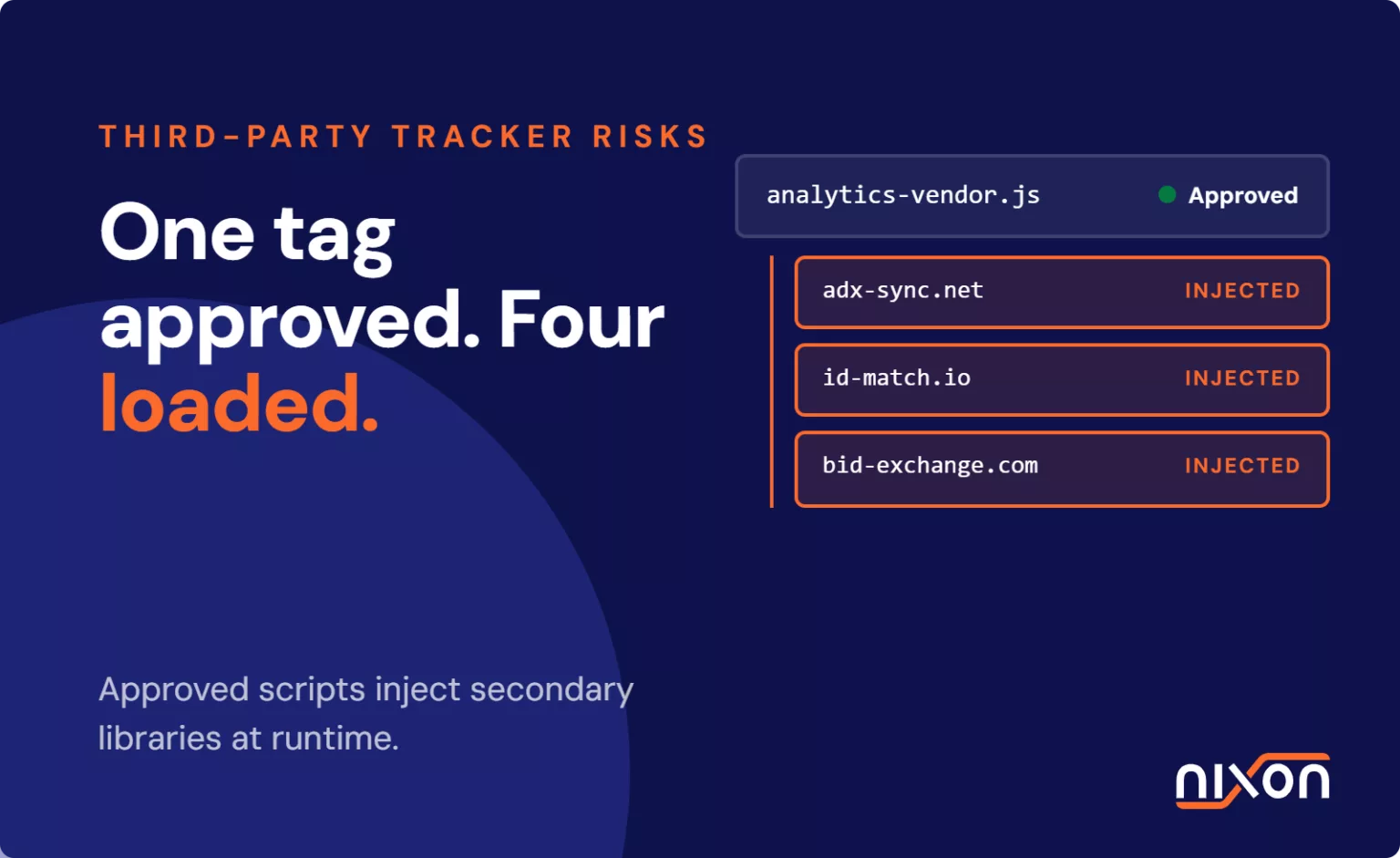
Piggybacking tracker risk occurs when an approved external script dynamically injects secondary and tertiary adtech libraries at browser runtime without technical authorization. This unmonitored script chaining creates severe data exfiltration channels and exposes personal identifiers to unvetted advertising endpoints.
Piggybacking takes place when an approved third-party script dynamically injects secondary libraries. These libraries do not appear in the origin page source code. An organisation may approve a single analytics vendor. That vendor container then fires requests to dozens of unknown advertising exchanges. This dynamic execution creates an unmonitored exfiltration pipeline. If an unvetted script accesses the DOM while a user submits a form, sensitive form values leak to remote advertising endpoints.
How do shadow tags bypass consent management?
A cookie banner is pure theatre if scripts fire on DOM load anyway. Banners show an interface; they do not automatically govern your browser network layer unless your engineering team explicitly ties triggers to consent signals. Secondary scripts often inject asynchronously after the initial page render. When that happens, consent management platforms fail to suppress them if a user rejects tracking. Regulators enforce pre-consent script suppression strictly. The CNIL guidelines on cookies and tracking devices make clear that non-essential trackers must remain inert until positive consent is recorded. Shadow scripts that execute regardless of user choices leave organisations exposed to regulatory fines.
Transatlantic data flows and regulatory scrutiny
Uncontrolled adtech tags frequently route telemetry through processing hubs located in non-adequate jurisdictions. When dynamic scripts capture online identifiers and forward them across borders without technical transfer safeguards, both privacy and security postures fail. For example, unmanaged Google Analytics 4 setups regularly forward client identifiers to US cloud infrastructure before establishing statutory safeguards. Similarly, Meta Conversions API client-side integrations leak hashed personal data to advertising endpoints without explicit consent. DPOs face enforcement scrutiny for unlawful data exports. CISOs face unmonitored data loss through unencrypted or unauthenticated third-party communication channels.
Technical failure modes in enterprise website tracker governance
Enterprise digital estates rarely remain static. Over time, normal corporate operations produce technical debt that prevents privacy and security tooling from maintaining accurate visibility.
Tag manager containers running unvetted custom HTML
Tag management containers frequently become dumping grounds for deprecated custom HTML blocks, inline JavaScript snippets and forgotten marketing experiments. In our audits, we regularly find agencies pasting complex tracking pixels directly into container triggers to support seasonal promotions. These custom code blocks lack version control, automated linting and dependency scanning. If an external content delivery network hosting an injected library suffers a compromise, that malicious payload runs directly on the enterprise domain. That compromise places every visitor session at risk.
Ghost subdomains and forgotten campaign landing pages
Enterprises running multiple brands regularly create distinct domains and temporary subdomains for product launches, hiring drives or local market activations. Once campaigns conclude, the central digital team frequently deprecates the primary landing page while leaving DNS records active. These orphan properties continue executing legacy scripts, abandoned CMP setups and outdated third-party tags. Managing compliance risks in a multi-brand website portfolio requires discovering these forgotten assets before bad actors discover dangling DNS records or regulators audit outdated tracking setups.
CMPs operating disconnected from client-side execution
A severe technical failure mode occurs when tracking tags fire on standard container initialization rather than verified consent events. Developers often set tag firing rules to All Pages or DOM Ready. When tags attach to native page lifecycle events, they execute milliseconds before the consent banner can initialize or read stored preferences. This implementation flaw completely detaches browser network requests from user privacy choices. Engineering teams must rewire container triggers to custom consent evaluation events and remove third-party trackers from your website that do not support conditional blocking.
Bridging the gap with unified deep asset discovery
Periodic manual spot-checks cannot secure dynamic digital estates. Enterprise organisations require automated asset discovery that bridges the operational gap between security and privacy controls. Teams audit and eliminate third party tracker risks through four technical steps:
- Crawl all public domains and subdomains to uncover orphan assets and dangling DNS records.
- Map every client-side script to its direct technical initiator and identify dynamic network beacons.
- Audit tag firing rules across multiple consent states, verifying that non-essential trackers stay blocked on reject.
- Route identified script vulnerabilities to the security team and consent bypass violations to the privacy office.
Establishing a single inventory of all client-side assets
To stop this exposure, both teams need one live list. That means cataloguing every active domain, embedded script and dynamic beacon across the estate. Instead of maintaining static spreadsheets that become outdated within days, security and privacy leaders require automated asset crawling. This tooling identifies direct script initiators and anomalous network beacons across the digital footprint. This centralised inventory provides both departments with a single source of truth regarding which vendors operate on which web properties.
Automated detection of new trackers and consent bypasses
Automated scanning engines analyse the actual network layer of enterprise web pages under multiple consent states. By testing pages with consent granted, rejected and completely unselected, discovery platforms detect scripts that fire prematurely or bypass user choices. Continuous analysis identifies anomalous network requests whenever a third-party script introduces secondary piggybacking tags. Implementing a continuous website privacy audit program ensures that new tracking deployments never go undetected across large website portfolios.
Shared workflows and automated issue routing for DPO and CISO teams
Unified discovery platforms translate technical findings into actionable alerts tailored to departmental responsibilities. When a rogue script appears inside a container, the security team receives immediate notification regarding unauthorised client-side script execution and potential exfiltration vectors. Concurrently, privacy officers receive compliance alerts highlighting specific GDPR violations, missing legal bases and consent bypass triggers. Centralised detection eliminates finger-pointing and accelerates technical remediation.
Manually verifying script behavior and data leakage across sprawling digital properties is slow and leaves blind spots between your security and legal teams. If you need unified visibility and automated tracking governance across your enterprise domains, explore the Nixon Platform to eliminate third party tracker risks and establish a live asset inventory across your portfolio.
Frequently Asked Questions (FAQ)
What are third party tracker risks for enterprise websites?
Third party tracker risks encompass both security and privacy exposures caused by external scripts. Security risks include client-side code execution, DOM tampering, and unauthorised data exfiltration via compromised vendor scripts. Privacy risks include personal data processing without valid consent, GDPR Article 5 and 6 non-compliance, and unlawful international data transfers to adtech networks.
How do third-party trackers bypass consent management platforms?
Trackers bypass consent management platforms when tag managers fire scripts asynchronously before the banner registers user choices. Additionally, piggybacking trackers evade banner controls by loading dynamically inside approved scripts. If the tag manager does not strictly block container triggers based on CMP signals, scripts execute network requests regardless of user rejection.
Why should CISOs care about marketing tracking scripts?
CISOs must monitor tracking scripts because they execute arbitrary JavaScript within user browsers with full DOM access. Attackers frequently compromise third-party script vendors to inject malicious code, harvest form data, or redirect traffic. Treating marketing tags as low-risk marketing tools creates an unmonitored client-side supply chain vulnerability across enterprise domains.
What is the difference between a privacy violation and a client-side security risk?
A privacy violation occurs when personal data is collected or transferred unlawfully, such as loading cookies prior to consent under GDPR or ePrivacy rules. A client-side security risk involves unauthorized script modification, data exfiltration, or exploitation of vulnerable browser code. An unvetted third-party script often triggers both issues simultaneously during a single session.
How does automated asset discovery resolve shadow tag risks across multiple brands?
Automated asset discovery crawls the entire portfolio to map all domains, subdomains, and active scripts at the browser network layer. It automatically detects unauthorized tags, piggybacking trackers, and consent bypasses across thousands of pages. This provides both CISOs and DPOs with continuous visibility and automated alerts to remediate shadow tags immediately.