
A cookie database serves as the operational single source of truth that bridges live website code with regulatory accountability. Most privacy teams only discover trackers when a consent banner scan fails. They also discover them when an external auditor requests records of processing. Relying on an unverified consent management platform list is not governance. Automated assumptions inevitably fail regulatory scrutiny. Web developers treat storage keys as functional application state. Marketers view them as attribution tools. Privacy professionals must account for every identifier written to user terminal equipment. Building a dedicated inventory transforms unverified technical data into defensible compliance documentation.
What a cookie database is and what it does
A cookie database is a structured operational register that documents every stateful browser identifier across digital touchpoints. It links low-level technical telemetry directly to legal baselines, vendor contracts and named business owners. This inventory creates verifiable transparency between live website code and public disclosures.
Baseline guides on what is a cookie on a website and what they do outline basic browser mechanics. Yet technical teams often dismiss storage keys as mere configuration. A verified registry turns those technical elements into auditable governance assets. Unlike a casual spreadsheet or a generic vendor catalogue, an enterprise registry tracks operational reality. It connects low-level network behaviour to specific privacy obligations. This connection prevents compliance drift across multi-brand environments.
Beyond static CMP label libraries
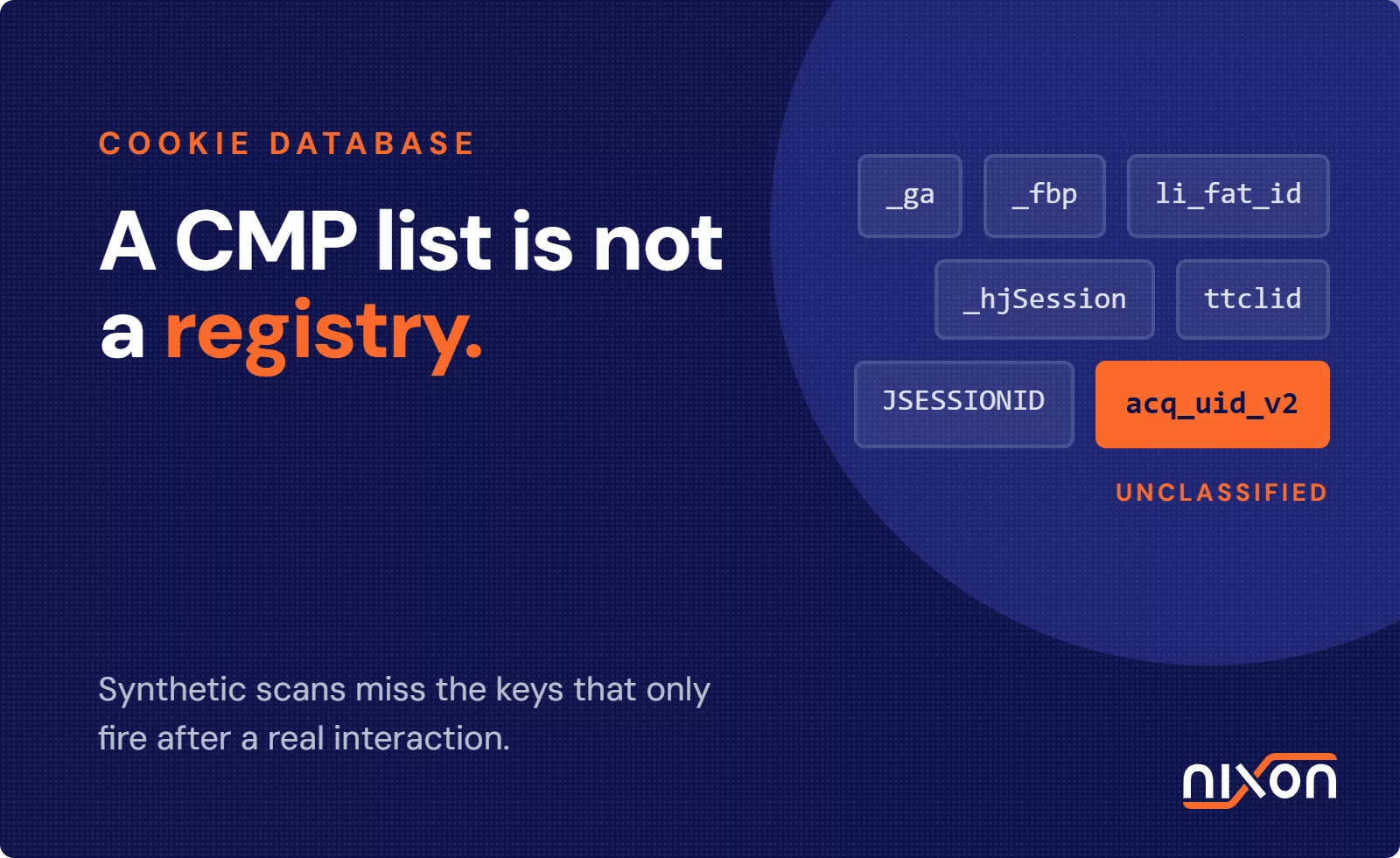
Most commercial consent tools ship with a static dictionary. These dictionaries automatically assign predefined labels to common tracking keys. However, static CMP libraries often fail to map custom analytic identifiers. They also struggle with dynamically loaded tag manager scripts. When engineering configures an in-house analytics service, standard dictionaries fail. They either mark keys as unclassified or apply inaccurate generic descriptions. In our audits, we see these discrepancies create immediate legal exposure. An operational database replaces these generic assumptions with validated records. These records reflect actual data flows, live deployments and signed vendor contracts.
The core operational fields of an active cookie database
To serve as an effective governance tool, the registry must capture three distinct tiers of data for every storage item:
- Technical tier: Log the exact key name like _ga or li_fat_id alongside the host domain, path, storage duration and flags such as Secure or SameSite.
- Operational tier: Name the internal team lead, the tag manager trigger, the initiating script URL and the external vendor collecting the payload.
- Legal tier: Document the lawful basis under Article 6, the specific business purpose, data retention schedules and the signed data processing agreement.
Why enterprise cookie usage demands a dedicated database
Modern enterprise websites rely on browser storage mechanisms to execute core functionality. They use storage to balance infrastructure loads, evaluate campaign performance and deliver personalised user journeys. Distinguishing between these diverse functions requires examining live network requests. Teams cannot simply guess intent from cookie names. When evaluating network traffic, teams must differentiate between first-party cookies vs third-party cookies. Domain provenance fundamentally alters both technical governance and regulatory risk exposure under global privacy frameworks.
Operational and security purposes
Technical teams deploy cookies to ensure infrastructure stability. Cookies also maintain user state across stateless HTTP transactions. Load balancers use routing cookies to pin browser sessions to specific backend servers. Application frameworks use anti-forgery tokens to protect users against cross-site request forgery attacks. Similarly, user interface preferences, digital shopping carts and consent choices require local browser storage. These mechanisms directly deliver services explicitly requested by the visitor. Therefore, they represent strictly necessary operational utilities rather than surveillance tools.
Analytics, personalisation and marketing attribution
Marketing and analytics departments use storage keys to measure audience reach. They monitor navigation flows and track multi-channel conversion funnels. These technologies generate pseudonymous hardware profiles. They also trace individual clickstreams across web sessions. Furthermore, scripts share audience engagement signals with external advertising platforms. Modern campaigns frequently depend on complex third-party tracking mechanisms to sync identity graphs across programmatic networks. Maintaining an updated registry gives privacy teams complete visibility into which advertising networks receive user telemetry.
Why CMP automated scans fail to provide true governance
Many organisations assume that running an automated crawler within their consent banner software fulfills their compliance duties. However, automated crawlers execute synthetic journeys. These synthetic paths rarely reflect real-world user paths or modern single-page application behaviour. Relying exclusively on automated vendor scans creates a false sense of security. It actively conceals compliance blind spots behind superficial reports. Even a properly configured OneTrust cookie consent setup requires deliberate categorisation governance. It demands direct API synchronisation and recurring manual verification. Consent software can only enforce the rules that administrators accurately configure, audit and maintain.
The blind spots of synthetic automated crawler scans
Standard CMP scanning bots load a homepage and click a few visible navigation links. Then, the bots terminate their automated session after several seconds. These crawlers miss trackers embedded inside authenticated customer portals. They also bypass conversion funnels and interactive forms. Third-party marketing scripts frequently drop persistent keys only after specific visitor interactions. These events include video playback, accordions and form submissions. Synthetic single-pass spiders remain completely blind to these event-driven tracking technologies.
Misclassified tags and unmapped first-party trackers
Automated vendor scanners identify tracking libraries through basic URL pattern matching. As a result, they regularly miscategorise custom or internally engineered tracking code. In our audits, we regularly see custom first-party tags misclassified as strictly necessary. This error happens simply because tags originate from the primary domain. Regular assessments using a cookie banner compliance audit methodology prove that production websites routinely fire unclassified marketing tags. This issue occurs even when teams run automated monthly scanner routines.
Bridging terminal storage to GDPR Article 30 records of processing
Data protection authorities do not view website tracking as an isolated technical configuration. Instead, supervisory bodies assess digital tracking through foundational data processing principles and terminal storage rules. Under Article 5(3) of the ePrivacy Directive, storing information or gaining access to information stored on terminal equipment requires prior informed consent. The only exception applies to technical storage strictly necessary for an explicitly requested service. A cookie database maps client-side storage keys to that statutory line. This mapping proves whether each tracker actually qualifies for an exemption.
Connecting technical telemetry to legal accountability
To establish institutional accountability, privacy teams must connect transient browser telemetry to formal compliance records. Under GDPR Article 30 requirements for records of processing activities, controllers must maintain structured compliance records. These records must cover processing purposes, data categories and recipients. When a marketing pixel drops an identifier to build behavioural profiles, that event constitutes personal data collection under the GDPR. A cookie database maps each specific storage key directly to the corresponding Article 30 record. This mapping ensures corporate legal documentation accounts for every digital marketing data flow.
Meeting EDPB transparency requirements for consent disclosures
Supervisory authorities have significantly raised the bar for valid consent over recent enforcement cycles. The EDPB Guidelines 05/2020 on consent confirm that consent requires granular information before storage occurs. Notices must clearly detail cookie lifespan, specific purposes and third-party recipients. A vague statement claiming a website uses cookies for analytics fails this transparency test. By maintaining a structured registry containing verified lifespans and vendor identities, organisations supply accurate metadata to their public consent banners.
How to build and maintain an active cookie registry
Start with a raw technical extraction across deep user funnels, not a vendor scan. Building an effective database requires moving away from static documentation and establishing repeatable operational workflows. When we construct these registries, the process begins by uncovering all live keys, scripts and local storage variables across production templates. Privacy teams must validate each discovered item with technical and marketing stakeholders to establish clear ownership. Once verified, teams integrate the registry with developer deployments. This step ensures upcoming software releases do not introduce undocumented browser tracking.
Establishing cross-functional ownership between legal and marketing
Maintaining accurate tracking records cannot remain an isolated task managed solely by legal counsel or web developers. Sustainable governance requires structured collaboration between legal compliance, digital marketing and web operations teams. Marketing teams must provide advance notice when onboarding advertising vendors or launching media campaigns. Technical teams must document storage parameters prior to production deployments. Meanwhile, privacy officers review these technical entries against vendor contracts and international transfer assessments. This cross-check ensures data processing remains lawful.
Auditing tag management pipelines and script release cycles
Even a meticulously constructed registry deteriorates quickly if it remains disconnected from day-to-day software development workflows. Tag management containers allow marketing teams to inject external scripts into live websites instantly. This process bypasses traditional code review pipelines and causes consent drift. Organisations must implement formal change-control gates within their tag managers. Every new pixel, tag and storage key must match an approved entry in the database before release. Periodic technical audits must test live user sessions against the registry. This testing identifies unmapped scripts before they create legal exposure.
A static spreadsheet or uninspected consent banner list cannot replace a validated cookie database when real-world website behaviour drifts away from written privacy notices. Establishing an active, fully integrated registry bridges this technical divide, transforming unverified script deployments into defensible compliance records. If your organisation needs an ongoing operational framework to continuously audit, remediate and maintain your tracking records across complex digital properties, talk to Nixon about a managed compliance program.
Frequently Asked Questions (FAQ)
What is the difference between a CMP dictionary and an enterprise cookie database?
A CMP dictionary is a generic external catalog that assigns automated, pre-set descriptions to common web tags. In contrast, an enterprise cookie database is an internal governance registry that documents custom trackers, local storage keys, internal business owners, specific legal justifications, retention schedules, and vendor contracts for your specific digital properties.
Does GDPR Article 30 legally require a specific cookie database?
GDPR Article 30 requires organisations to maintain records of processing activities, covering purposes, data categories, and recipients. Because client-side cookies and storage keys collect personal data like unique device identifiers, teams need an accurate technical database to document those digital processing operations and map them directly into their formal records.
How often should privacy teams update their cookie database?
Privacy teams should update their database whenever teams release website updates, publish tag manager containers, or launch marketing campaigns. At a minimum, teams should perform monthly automated technical audits alongside quarterly cross-functional reviews to capture untracked scripts and prevent consent drift between live browser behavior and declared notices.
Can a cookie database track local storage and session storage keys?
Yes, an enterprise cookie database should track all client-side storage technologies, including HTML5 local storage, session storage, and IndexedDB keys. Article 5(3) of the ePrivacy Directive governs any storage or access to information on user devices, meaning non-cookie identifiers require identical technical documentation and legal basis mapping.
Who within an organisation should own the cookie database?
The data protection officer or privacy legal team should own the database governance framework and compliance criteria. However, maintaining the data requires active co-ownership with web development teams who control front-end code releases and digital marketing operations teams who manage third-party tags and analytics deployments.