Website wiretapping lawsuits are civil claims under state wiretap laws alleging that third-party tracking scripts, chat widgets and marketing pixels intercept consumer communications in transit without prior consent. Plaintiffs do not reverse-engineer complex backends; they simply open browser developer tools to record tracking pixels firing before visitors touch a consent banner. When analytics or session-replay scripts execute on initial load, your front end generates forensic evidence for litigators. Sending outbound browser payloads to ad networks without affirmative consent turns basic tracking code into active statutory claims.
How do state wiretap statutes apply to website tracking code?
State wiretap litigation relies on statutes passed decades before modern web browsers existed. In California, litigators apply the California Invasion of Privacy Act directly to client-side marketing tags. Under California Penal Code § 631, liability hits anyone who intercepts or reads messages in transit without all-party consent. Courts increasingly treat HTTP payloads between a consumer browser and a website as protected electronic communications.
The legal shift from telephone taps to browser payloads
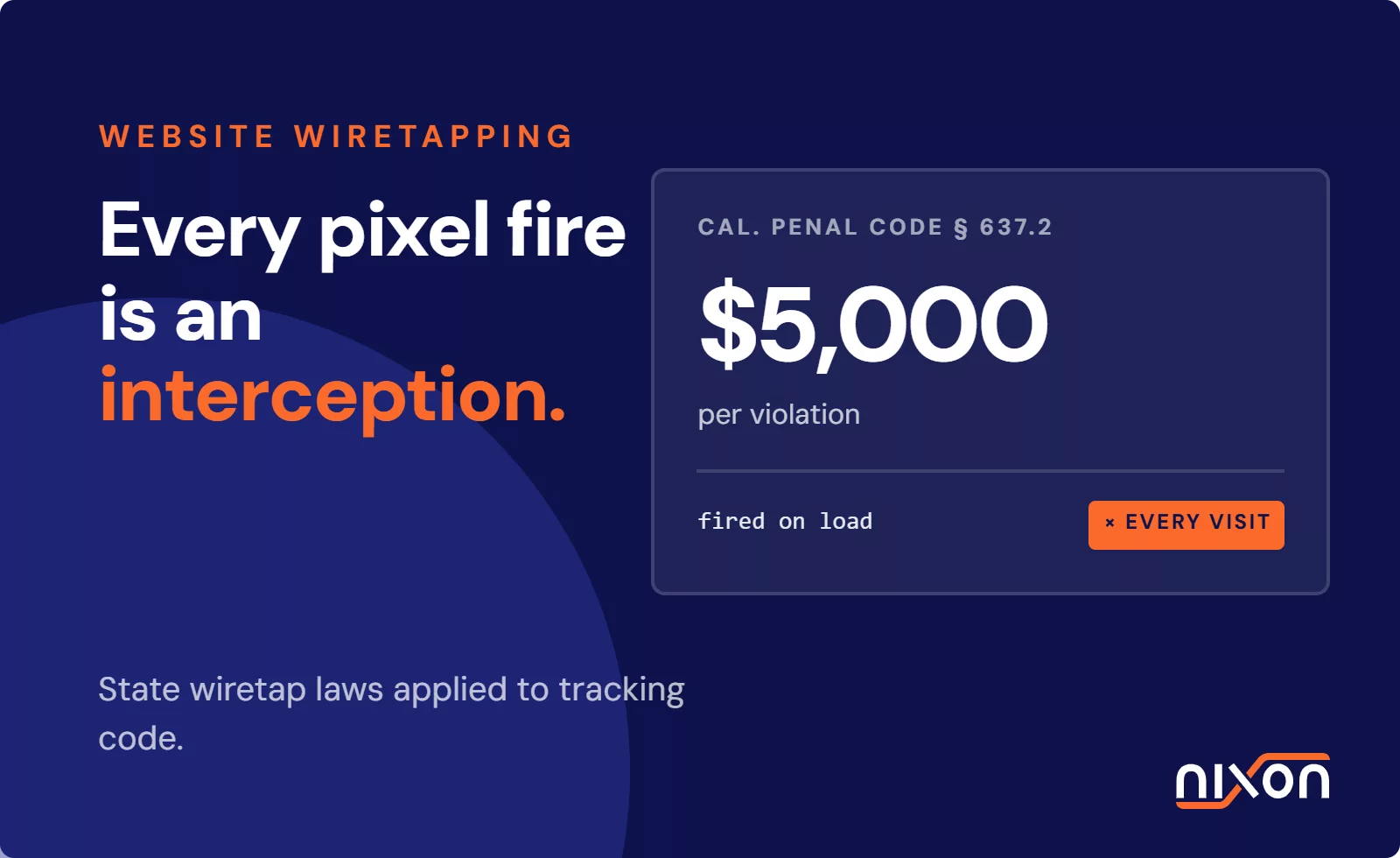
Originally designed for physical taps on telegraph lines, these statutes are now being applied directly to browser network calls, with litigators framing embedded tracking code as an unauthorized tap. The financial risk accumulates quickly. Under California Penal Code § 637.2, statutory damages reach $5,000 per violation. Because each unconsented script execution can count as an individual interception, high-traffic websites face massive exposure from standard marketing setups.
What constitutes content under wiretap claims?
Defense teams often claim that marketing pixels only transmit routine technical metadata. Yet judges continue to broaden what qualifies as protected communication. Courts regularly treat URLs with descriptive query parameters, search terms and form entries as substantive message content. When a pixel passes visited product categories alongside unique cookie IDs, judges often find that actionable communication content was shared without authorization.
Why plaintiffs use browser network logs as primary evidence
Plaintiffs build these cases with almost zero investigative overhead. An investigator points a headless browser at your landing pages and exports the network HAR file. If third-party endpoints collect identifiers before any user interaction, plaintiffs have proof of an interception in transit. In our audits, we regularly see this exact scenario across commercial landing pages. This reality makes evaluating CCPA compliance on US websites essential alongside front-end script behavior.
Key court trends across pixel and session-replay litigation
Judges increasingly dismiss the traditional defenses that companies relied on for years. Early defense arguments claimed that third-party vendors act merely as software extensions of the host website. Today, courts review software licenses and API contracts directly. They check whether advertising vendors use collected events to train their own algorithmic networks.
Meta pixel data sharing in retail and consumer services
Rulings on the Meta pixel show deep skepticism toward standard defense positions. Courts reject the claim that pixels are passive software tools when vendors reuse event data for cross-site targeting. If an ad network can feed event data into its own behavioral models, courts view that vendor as an independent third-party eavesdropper. As a result, routine tracking on retail websites now faces the legal scrutiny once reserved for private conversations.
Session-replay tools as third-party eavesdroppers
Session-replay tools face identical scrutiny under state wiretap laws. These scripts record mouse movements, clicks, keystrokes and DOM mutations to reconstruct user sessions. In several state actions, plaintiffs showed that recording scripts forwarded user keystrokes to external cloud servers in real time. Because this transmission happens while the visitor interacts, courts often view replay vendors as uninvited third parties listening in on live interactions.
The failure of browsewrap and buried privacy notices
Website operators frequently defend themselves by citing privacy links in the page footer. Courts consistently hold that browsewrap terms fail wiretap consent thresholds. Passive notices that visitors never see cannot provide valid consent for real-time script surveillance. When an unconsented script fires on document load, courts reject buried notices, leaving companies exposed to statutory claims.
Why standard CMP banners fail to prevent website wiretapping lawsuits
Setting up a commercial consent banner does not guarantee that your website blocks data collection. A massive technical gap separates visual banners from actual browser execution control. Many consent tools load purely as visual overlays. They display opt-out prompts while background containers keep firing tracking scripts across initial requests. This mismatch gives teams a false sense of security while handing clean evidence to litigators.
Consent banners as cosmetic overlays
When a browser loads a webpage, network sockets execute bundled scripts within milliseconds. If a consent banner shows a visual notice without halting network requests, pixels fire regardless of user choice. Litigators do not care whether a banner was visible; they look at whether an outbound POST request hit an advertising vendor before user input was registered. A banner that appears while scripts load in parallel stops nothing.
Tag manager triggers executing before user choice
Most script deployments depend on container management tools to govern external code. Without strict tag manager consent governance, default initialization rules fire marketing tags on initial page load. Marketing teams frequently attach conversion pixels to standard page-view events instead of consent-verified signals. In our audits, we regularly see containers firing Meta and TikTok pixels hundreds of milliseconds before the banner finishes rendering. Under this setup, third parties collect user actions before the CMP can evaluate user preferences.
The risk of misconfigured tag orchestration
Enterprise consent platforms include technical controls to block outbound requests, but configuration errors break them. Even a detailed OneTrust cookie consent configuration leaves a company exposed if tags trigger before explicit signals register. If container logic fails to tie script execution directly to recorded opt-ins, the banner acts only as passive decoration. The underlying scripts keep sending network calls immediately, creating direct litigation targets.
How to audit client-side tag leakage before demand letters arrive
Defending against wiretap risk requires moving beyond legal policies to audit browser execution directly. Compliance teams must verify what scripts execute before visitors click any button. If sensitive URLs, search strings or device IDs leave the browser on page load, your website produces actionable exposure every day.
- Map initial page-load network payloads across core customer funnels.
- Enforce strict prior consent inside tag management container rules.
- Establish recurring client-side verification to detect configuration drift.
Mapping initial page-load network payloads
Start your audit by reviewing outbound network streams across high-traffic landing pages, checkout paths and dynamic forms. Engineering teams must inspect POST and GET requests sent before banner interaction occurs. Look specifically for pixels sending query strings, cookie values or interaction events to third-party endpoints. Isolating tags that ignore blocking rules lets you remove unauthorized code before an external party spots it.
Enforcing strict prior consent in your tag architecture
Once you document unauthorized endpoints, update your tag containers to require strict prior consent. No conversion tag or session-recording script should ever fire on standard window load events. Instead, every tracking script must wait for custom consent events pushed by your CMP. If a user rejects tracking, or leaves the page without answering, those network requests must remain completely blocked.
Establishing recurring client-side verification
Front-end tags shift constantly because marketing teams regularly add campaign parameters and new integrations. Checking this once every quarter does not work when marketing teams update container tags weekly. A single manual check captures only one snapshot, leaving your engineering team blind to subsequent container edits that silently reintroduce unauthorized calls. While multi-brand enterprises often deploy continuous monitoring across their domains via Nixon Platform, individual landing pages and high-risk conversion flows need precise baseline testing.
When tags drift between releases, manual network sniffing will not catch the leaks in time. Audit your trackers with Nixon Pro to map every outbound payload before litigators run their own headless scrapers to build a claim against you.
Frequently Asked Questions (FAQ)
What triggers website wiretapping lawsuits under state laws like CIPA?
Lawsuits are triggered when websites deploy tracking scripts, pixels, or session-replay tools that transmit user communications to third-party ad networks before visitors grant prior consent. Under statutes like CIPA Section 631, routing browsing events, query strings, or keystrokes to external vendors without explicit authorization is treated as illegal interception in transit, exposing operators to statutory damages.
Can a company be sued for wiretapping if user data is anonymized?
Yes. State wiretap statutes focus on the unauthorized interception of the communication itself rather than whether personal identifiers were stripped out. If a tracking script captures and shares dynamic browsing content, search parameters, or user interaction journeys without prior consent, courts can find liability under wiretapping laws regardless of backend hashing or anonymization claims.
Does a standard cookie banner protect against CIPA claims?
No. A cookie banner that merely renders visual notices without blocking client-side scripts fails to prevent wiretapping liability. If marketing pixels or recording tools fire in the background on page load before the user grants explicit consent, the transmission still constitutes an unauthorized interception, giving litigators direct technical evidence of non-compliance.
Which marketing and tracking scripts are most frequently targeted?
Plaintiffs primarily target advertising conversion pixels like the Meta pixel, session-replay tools that record mouse movements and DOM interactions, and embedded customer chat widgets. Any third-party integration that records user input, URLs, or interactions in real time before consent is obtained carries significant exposure under state wiretapping laws.
How do plaintiffs' attorneys collect evidence for wiretapping complaints?
Attorneys rely on automated headless browsers and developer inspection tools to record HTTP network traffic on initial page load. By logging pre-consent GET and POST requests that transmit identifiers, URLs, and browsing events to third-party endpoints, litigators secure verifiable proof of unauthorized interception without needing backend access or complex reverse-engineering.